This site will be shut down in

Wednesday, July 18, 2012

First Superstar of India Rajesh Khanna's demise

Rajesh Khanna (1942-2012)
Yesteryear Bollywood superstar Rajesh Khanna passed away on Wednesday afternoon (July 18, 2012) after a prolonged illness. He was 70. News of Khana's deteriorating health  has been making rounds lately and the actor was reported to have visited the hospital thrice due to weakness and BP problem.

He breathed his last at his Bandra house in the presence of his physician and all his family members including  son-in-law Akshay Kumar who returned from one of his shoots abroad in wake of father-in-law's ailment.

Rajesh Khanna shot to stardom between 1969 and 1972 after 15 consecutive solo superhits and is considered the first 'superstar' of Indian cinema. He appeared in 163 feature films and did 17 short films. 

He won three Filmfare Best Actor Awards and was nominated for the same fourteen times. He received the maximum BFJA Awards for Best Actor (Hindi) – four times and nominated 25 times. He was awarded the Filmfare Lifetime Achievement Award in 2005.

He made his debut in 1966 with Aakhri Khat and rose to prominence with his performances in films like Raaz, Baharon Ke Sapne, Ittefaq and Aradhana

Rajesh Khanna was a member of Parliament for the Congress Party, from the New Delhi constituency, where he won the 1992 by-election, retaining his seat until the 1996 election. When Khanna was M.P he worked full time as a politician and did not accept new acting assignments. He had since been a political activist for the Congress Party and campaigned for Congress in Punjab for 2012 elections.

The nations mourns the demise of this legendary actor and fondly remembers him for his memorable work.

- EFNI

Saturday, June 16, 2012

Assamese singer Kalpana Patowary resurrects Bhojpuri Shakespeare

Indian folk music goes global, thanks to Bhojpuri singing sensation of Assamese origin, Kalapana Patowary with the launch of her new album The Legacy of Bhikhari Thakur. Produced by EMI/Virgin records, the album is a tribute noted Bhojpuri litterateur Bhikhari Thakur. It was launched in Mauritius on the 4th of June 2012, by the country's Vice Prime Minister and Minister of Public Infrastructure Mr. Anil Kumar Bachoo and Mr. Mookhesswur Choonee, Minister of Arts and Culture.

The richness of Bhojpuri mores have perhaps been shadowed by the massive popularity of double meaning hip shakers, thanks to the competitive rating points driven entertainment industry. It therefore comes as a surprise when one of the most popular Bhojpuri vocalists decides to stream aside from the rat race and explore the lost works of Bhikhari Thakur, fondly known as Shakespeare of Bhojpuri literature for his contribution to poetry and drama.

Assam born singer Kaplana Patowary has carved a mighty niche for herself in the entertainment industry having lent her vocals to a numerous Bhojpuri songs as well as Bollywood numbers including films like Billo Barber and De Dhana Dhan. Although she has a myriad of folk and popular songs to her credit, Bhojpuri music has been her most dedicated foray.

Born in 1887, Bhikhari Thakur’s creative sojourn began late in his life for he was an illiterate until quite a few decades of his life. He learnt the three Rs from a shopkeeper when he went to Calcutta following a family tradition of working in the city. The stark social and cultural variations of his village and Calcutta, as well as works of Raja Ram Mohan Roy inspired him to express his experiences through literature. On returning to his village Bhikhari Thakur formed Bhikhari Thakur Natak Mandali thus creating a theatre form called Bidesia. Unlike conventional poets and dramatists, Thakur’s work took a dig at the redundant ways and customs of the society of his. One of his most noted works includes the tale of a woman in a village whose husband leaves the village to work in a but she still has physical desires, so she gets involved with another man and has a child.

Inspired by the contemporary nature of Thakur’s writings, Kalpana felt a need to share his work with a present day global audience. It turned out to be a mammoth task as the material available on Bhikhari Thakur is negligible. Luckily her rendezvous with a 98 year old dancer from the Bhikhari Thakur Natak Mandali gave her a first person account of the experiences of Tahkur’s legend as well as well walked her through his works.

Titled The Legacy of Bhikhari Thakur, Kalpana’s tribute to the Shakespeare of Bhojpuri literature has nine melodious tracks, the lyrics of which were penned down by Thakur himself. His memorable poems on immigration and unemployment rendered by Kapalana's powerhouse vocals have been welcomed with warmth in many parts of the globe. It has been launched in France and Mauritius and a launch in is scheduled in the foreseeable future. It's comes as no surprise that EMI/Virgin Records has undertaken the risk of pricing this Bhojpuri album at Rs. 195. The Legacy of Bhikari Thakur takes Bhojpuri music from the masses to the classes.

- by Parmita Borah

Wednesday, June 13, 2012

Kindgom of Ghazals loses its King

After Jagjit Singh another golden voice has departed from the world of Ghazal with Mehdi Hassan's demise.

Mehdi Hassan (July 18, 1927 - June 13, 2012)
Born into a family of traditional musicians, Mehdi Hassan was the 16th generation of hereditary musicians hailing from the Kalawant clan of musicians. He started performing at a young age and the first concert of 'dhrupad' and 'kheyal' with his elder brother is reported to have been held in Fazilka Bungla.

After the Partition of India, 20-year-old Hassan and his family migrated to Pakistan and suffered severe financial hardships Mehdi started working in Chichawatni, in a bicycle shop. He later became a car and diesel tractor mechanic.Hassan's passion for music however was never deterred by his personal struggles. Hassan's struggles gradually ceased after receiving an the opportunity to sing on Radio Pakistan in 1957, primarily as a 'Thumri' singer, which earned him recognition within the musical fraternity.

Mehdi Hassan is a recipient of multiple prestigious awards and honours: the Tamgha-i-Imtiaz granted to him by Gen Ayub Khan; the Pride of Performance bestowed on him by Gen Ziaul Haq; and the Hilal-i-Imtiaz conferred by Gen Pervez Musharraf. he received the Saigal Award in Jalandhar, India, in 1979, and the Gorkha Dakshina Bahu Award was given to him in Nepal in 1983.

This Indian born Pakistani Ghazal maestro breathed his last after battling with a prolonged illness on on 13 June 2012.

- by Parmita Borah

Thursday, June 7, 2012

Ruskin Bond celebrates 25th anniversary of Penguin in Bangalore

Ruskin Bond at Landmark (Photo: Jim Ankan Deka)
Ruskin Bond, author of many widely sought after books, was at the Landmark store in Forum Mall, Bangalore, on June 6, 2012, to release his new book of poems "Hip Hop Nature Boy and Other Poems" published by Penguin Books India. The event "Meet Ruskin Bond at Landmark" was organised by Penguin Books and Landmark to celebrate their 25th anniversary this year.

With around 200 spectators, the event was grand and aesthetical. After the inauguration ceremony, the author cut a cake along with his favourite audience - children, recited a poem from the new book, answered few questions of his fans and signed autographs.

Ruskin Bond is an  Indian author of British descent born in Kasauli, Himachal Pradesh in 1934. His first novel "The Room on the Roof", written when he was seventeen, received the John Llewellyn Rhys Memorial prize in 1957. He received the Sahitya Academy award in 1993 and the Padma Shri in 1999. Presently he is staying in Landour, Mussoorie, with his extended family.


Ruskin Bond reciting a poem from his book Hip Hop Nature Boy and Other Poems (Photo: Jim Ankan Deka)

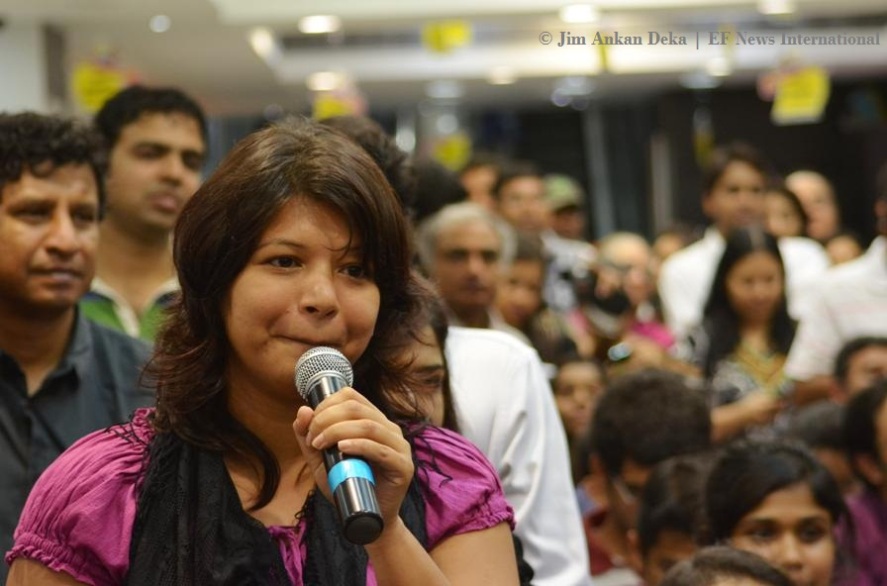
Audience asking questions to Ruskin Bond (Photo: Jim Ankan Deka)


- EFNI | Jim Ankan Deka


Thursday, May 24, 2012

Jazz version of 'Tere Bin Nahi Lagda' releases online

As a tribute to legendary singer Nusrat Fateh Ali Khan, Jim Ankan Deka and Ritwika Bhattacharya, the musician duo from Bangalore released 'Tere Bin Nahi Lagda' online.

'Tere Bin Nahi Lagda' was originally composed by the legendary singer for the movie 'Kachche Dhaage' in late 90s and since then it became hot favourite of all Sufi lovers. While there is way no match the musical genius of the noted singer, the new composition is certainly an interesting rendition of the virtuoso's soulful melody.

Ritwika's Sufi styled vocals and Jim's incorporation of jazz elements don't simply echo Nusrat Fateh Ali Khan's original composition, but paraphases it as contemporary fusion.

'It's a humble tribute to the incredibly gifted maestro', the budding musicians said. The duo had earlier recorded the famous song 'Ganga' by Dr. Bhupen Hazarika.

The song was recorded in Eastern Fare Studio in Bangalore (Eastern Fare Music Foundation) and was released online on May 13, 2012. The song is available for streaming on Reverbnation, Youtube and iTunes.

- SpicyPR

Monday, April 23, 2012

Inner Power Of Music And Music Therapy

Music remains part and parcel of human life. It has close affinity with man’s happiness and sorrow. There is no man on earth who has never moved by the sweetness of music. Even the cruelest one also not alienated from it. In this regard I remember a story about the infamous Mussolini who was suffering from insomnia or sleeping disorder due to tension. By the same time Indian classical singer and the representative of Gwalior Gharana Pt. Omkarnath Thakur happened to visit Italy as a part of his Europe tour. Hearing his presence in Rome Mussolini invited him to his court where he presented Indian classical music. The music had a deep effect on Mussolini and led him to sleep and thus he was cured of his sleeplessness. The same singer also calmed down a roaring angry lion in the Kabul zoo by his rendition of Kaphi raga. Similar stories are found in ancient India where in the court of Akbar, Mia Tansen produced fire by Deepak raga and brought rain to extinct the fire by the perfect rendition of Mallar raga.

Today we will discuss about a new and emerging field – Music Therapy. Music therapy has already gained popularity in the western world and even very recently penetrated the Indian subcontinent. Music has a promising role in the field of medical science. Music has the inner healing power which is unique. Today the use of music in hospitals, rehabilitation centers, schools, hospices, wellness centres and even in fitness centres has gained momentum. The relationship between music and medicine has become even sweeter than before and more systematic and research oriented. This relationship can rather be compared with the length and breadth of threads in the loom.

In the modern world music therapy was implemented for the first time for the benefit of the wounded soldiers in the World War II. The system of use of music to heal body and mind with a fixed target can be termed as Music Therapy.

In India people knew about the power of music from the days immemorial. In Samaveda the rules of raga rendition are available for treatment of diseases. In Ramdas Goud’s ‘Hindutva’ (1985, pp.85) there is mention of a book named ‘Sabdkoutuhal’. The one thousand slokas consist in that book were divided into three chapters. The first chapter describes about the treatment of different diseases with the use of sound and mentioned about ‘word medicine’. The uses of different instruments were recommended for different diseases. In the third chapter, there is a description about the removal of sickness by ‘shravan’, ‘manan’ and ‘kirtan’. Another book ‘Deval Sutra’ also enlightens about the rendition of ragas to cure diseases. It has been already proved that Indian raga music has enough healing power in treating diseases. Each raga has its own healing capacity. If the singer or player has deep knowledge about the rules of raga and expertise in performing the same can have impact on the health of the receiver whether it is mental or physical. A particular raga may act differently on different persons. Therefore, it is the prime duty of a music therapist to carefully select a raga taking into account the mental state of the receiver. Narad said in the fourth chapter of ‘Sangit Makarand’----

Ayurdharmayasobuddhi dhanadhanya phalam labhet |
Ragabhivriddhi santanam purnaragah pragiyate ||
Sangramarupalavanyam viraham guna kirtanam |
Sharavena pragatavyam lakshyanam gaditam yatha ||
Vyadhinashe, shatrunashe bhaya shoka vinashane |
Vyadhi daridrya santape, vishamgraha mochane ||
Kayadambaranashe cha mangala vishasamhrite |
Audavena pragatavyam gramashantyarthakarmani ||

-means Purna Raga should be rendered for longevity, faith, fame, intelligence, wealth, prosperity and fertility. Shadav Raga should be rendered in case of struggle, beauty, sorrow and other appraisal. Audab Raga should be rendered to remove unhappiness as a result of poverty, sickness and grahadosha.

The earliest written evidence about the effect of music on human body was found in the ‘Medical Papyri’ of 1500BC where there was mention about the increase of women fertility rate with the healing effect of music. Same kind of evidences are also found in some Greek stories.(Grove’s Dictionary of Music and Musicians, 1995, p.417-418).

Today music therapy is equipped with more rules to be able to prove it as an emerging scientific area. Russian scientist Dr. Dosiel has given the following postulates on the anatomical effect of music -----
  • Music effects on the blood circulation.
  • Music can maximize or minimize blood pressure.
  • Frequency of heart beat may vary through the application of music.
  • Amplitude, magnitude and tonal structures may effect on the blood pressure and frequency rate.
Today many music therapists follow Dosiel’s Theorem.

Indian or other Oriental music has better healing power in comparison to Western music. To justify the same two music therapists Charles Keele and Angeliki did an experiment. They divided some psychiatric patients into two groups. One group was exposed to Western music like the symphonies of Bach, Motzart, etc. and the other group was exposed to different ragas of Indian Classical Music. After the experiment it was found that the group exposed to Indian music responded more positively than the other group which helped in repairing of motor skills.

Western music is more systematic based on harmony and runs on fixed notes whereas Indian music is based on melody and more liberal. Improvisation is the basic characteristic of Indian music. Though notation systems are followed adherence to the notes are not fixed like western music. Musicians have enough freedom and their area of expression is much broader. Therefore, same raga may be rendered differently by different singers despite adhering to the rules of the raga. In Western music the role of improvisation is limited. Of course, Jazz is an exception to some extent. Russian scientist and musician Dr. Bokhaniski suggests the use of musical piece of Chopin to treat insomnia. While supporting the view Dr. Yung Hunter says that it also reduces physical pain. Dr. Herbert Spencer proved that fast music helps the patients with low blood pressure and the slow music with high blood pressure. Music has also positive effect on serious and last stage patients. Music is highly useful for the children with mental retardation.

Music therapists have a broad and diverse working ground. Music therapists have connection with everyone include children, adolescents, aged or old. Further, they have a challenging job with mentally retarded, visually impaired, deaf and dumb, criminals, addicted as well as normal ones. Even music has a great role to play in the world of sports.

Music therapy is a homogeneous combination of music, psychology, anatomy, audiology, computer and mathematics. Physiotherapy and Occupational therapy will be more effective if music therapy is associated with them. Sometime art, dance, drama and poetry are also taken as medium. By now in the west dance has emerged as a separate branch of therapy called ‘Dance Movement therapy’.

Other than classical music folk and traditional music has an inbuilt therapeutic element known to man since time immemorial. Man has been expressing his mind and feeling through music. He has the expertise in using music and traditional instruments in different occasions, be it birth, death, marriage, war, production of crops or to please the rain, thunder, sun and many other lesser gods.

Today there are dearth of researchers in the field of Music in true sense which, despite its being part and parcel of human life, is left neglected, undiscovered and unresearched due to lack of recognition as a field of higher scholastic achievement rather than a mere tool of entertainment. Therefore, I would like to invite scholars from different knowledge areas to come forward and use in depth potential and power of music to strengthen human knowledge so as to enable them to use the outcome result for the greater benefit of the human population.

Today music therapy is taught up to doctoral and post doctoral level in many universities and institutions around the world. Even in India, though lately, music therapy has been given place in Apollo Hospitals, AIIMS, etc. Even Apollo Chennai has introduced a one year post graduate diploma programme in Medical Music Therapy. Some other private trusts are also simultaneously working in this field including prestigious Nordoff-Robbins Music Therapy Centres, London who has a branch in India. Among the universities Madras University experimented with some music therapy projects with positive outcomes. Today Music Therapy can rightfully be considered as a branch of alternative medicine.

-by Ankur Deka

Friday, April 13, 2012

Rongali Bihu: Heralding spring

Photo by Kangkan Hazarika
From time immemorial, Assam has had various kinds of folk songs and dances sung and played at different seasons of the year by the common folk of the countryside when festivals are held to make merriment of various kinds. Among the festivals, the new year festival is celebrated with great pomp and grandeur in the spring season when the sky is overwhelmed with the utterances of the coming of the "Bordoichila".

All classes of people, irrespective of caste, creed and religion take part in the new year spring festival. This festival in Assam is known as Rongali Bihu or Bohag Bihu. The most significant part of the spring festival is the songs and dances which are sung and played expressing delight and also the love for life, society and friendship. Young girls from the countryside sing and dance to welcome Bihu. Nature begins to bloom with new colours and a new urge for recreation. This is expressed through various rites and festivals, song and dances and merry making.

Among the seasonal festivals of Assam, the Bihus have a wider popularity. There are three Bihu festivals in Assam which mark the agricultural season. The first is celebrated at the beginning of cultivation. The second is at the time when the seeds sown begins to appear as seedling, and the third is at the time of harvesting. The Rongali Bihu or Bohaag Bihu or the spring festival is celebrated at the beginning of the period when seeds are sown in the field. Bhogali or Magh Bihu is observed at the period of harvesting of crops. Further, there is the Kati Bihu or Kongali Bihu when agricultural fields are blooming with new crops - greenish in colour at first and gradually turning into yellowish colour and the time for harvesting approaching. In Bohag there is the completion of the sowing of seeds and there is the hope of getting good returns. The returns depend on the fertility of the earth and good weather. In order to propitiate nature, men and women, young boys and girls begins to worship nature in many ways.

Photo by Vikramjit Kakati
Of the three Bihus, the Bohag Bihu is the most important ceremony. It is celebrated when the Assamese new year enters on the Chaitra Samkranti day. In such a time spring touches the naked earth - everywhere there appears new life. During Rongali Bihu, nature is enlivened with a new spirit. It takes on a new life, with new colours in the sky, and in the forests and hills. Minds of men are vibrant with joy and they come out to make merriment through dances and songs. The girls come out with traditional dresses signifying their ripeness of youth. The red Riha is the symbol of ripeness. During this period nature is gay with new urge for creation. Nature also welcomes the song birds like the cuckoos who "pour out their music". The sky is bright and blue and occasionally "rolling drum of the thunder cloud is heard". The young boys wearing typical Bihu dress with Gamocha in the head come out with drums and different kinds of flutes.

Bihu songs are typical folk-songs. The songs have deep meaning appealing to the mind. The songs are sung in the fields, by the river side and under the banyan tree. In the Bihu songs, there is the depiction of love - sweet love of man to man, love towards nature - river, forest, hills and birds.

Bohag Bihu or Rongali Bihu festival continues for seven days. The Samkranti day of Chaitra (generally April 14) is the Goru Bihu (Cow Bihu). Other Bihus are Manuh Bihu, Hat Bihu, Senehi Bihu, Maiki Bihu, Rongali Bihu and Sera Bihu. The first day of the Bihu is the Garu Bihu which is celebrated to pay respect to the cows, which are used in agriculture.

The remaining days of the Bihu are celebrated in merry making and participating in other social activities. The elders offer blessings to the younger ones. The young boys and girls pay respect to the elders offering them traditional Gamochas.

The spring festival or Rongali Bihu has come a long way since its inception when people had to depend solely on nature. Gradually changes have taken place in the celebration of the Bihu and at present it has occupied a place of social coherence, brotherhood, fellow feeling, etc. Rongali Bihu is now the most important festival, which has been accepted by all classes of people as the meeting ground of unity in diversity. Rongali Bihu has been able to bring about a new philosophy of life — to live together, to sing together and to be one.

About Me

Powered by Blogger.

Blog Archive