This site will be shut down in

Tuesday, January 29, 2013

Django Unchained (movie review)

A spaghetti western with a black cowboy - Who else you reckon would venture into a territory like that? Another hint - a ruthlessly violent, gore and cold blooded revenge saga - sounds familiar? Good Guess - Quentin Tarantino it is. The man's back with his large red font title credits, variegated background score and of-course a cast to die for as he adds another feather to his cap - Django Unchained.
Django Unchained (poster)
Before I begin my review, let me remind you that there are some flicks that owe its ingenuity to a great story (The reader, if I may), some to it's crisp screenplay (let's say The Social Network, or Tarantino's much acclaimed Pulp Fiction), some for direction (for instance The Hurt Locker); and some stand out based on sheer brilliance of performance. Django Unchained is one such movie. So if you are expecting an evenly paced, action packed western, I'd say cancel your movie tickets and shut down that torrent window right now.

Set in the antebellum era (the era in the Southern United States preceding the Civil War), Django Unchained is a stylish account of Django's (a black slave) pursuit to free his wife from a cruel and charismatic plantation owner Calvin Candie. His is aided in this quest by his mentor - Dr. King Schultz, a German Dentist/Bounty Hunter who trains him in bounty hunting and mastering a sidearm.

Django is a caterpiller, so to say. His character does not attain resplendence until the second half of the film and initially appears like a side kick to Schultz. Skilfully portrayed by Jamie Fox, the transition of Django from a hot headed slave to a shrewd, revenge seeking cowboy is gradual and credible. Christopher Waltz's portrayal of Dr. King Schultz is mildly enigmatic. It is difficult to fathom why a bounty hunter, who kills outlaws in cold blood, would take a black slave under his wing and helps him save his wife? Or why would he be so disturbed at Calvin Candie's orders to have of his Mandingo fighters be torn apart by attack dogs. (Yes. The film's not for the weak-hearted). Speaking of Calvin Candie, Leonardo Di Caprio's performance is one of his very best. His condescending conversations with Schultz were almost like a metaphor of revenge on Christopher Waltz for playing Hans Landa in Inglourious Basterds AND winning a Oscar for it. Yes, Leonardo Di Caprio was that good. It's a shame he wasn't even nominated for the Oscars. The rest of the cast doesn't have much scope to be remembered, honestly. Samuel Jackson's as the conniving house slave Stephen does leave his mark though.

Jamie Foxx and Christopher Waltz (Django Unchained)
Unlike other Tarantino Flicks, Django Unchained has a linear narrative, excluding a few flashback scenes. (Visually the flash backs scenes were the best of the lot). Despite being set in the antebellum era and focussed on major social issues like slave trade, the film's historical verisimilitude can’t be said to be one of its highlights. It is brazenly and relentlessly about style, and action. Amidst the bloody mayhem, Tarantino does create some lighter moments with clever dialogues and smart comic timing - one of the funniest scenes being a group of Ku Klux Klan members gunning for Dr King Schultz (Christopher Waltz) and Django (Jamie Foxx) argue over the peepholes in their white hoods. Django's unfamiliarity with high brow English too triggers some laugh out loud moments.

Django Unchained is a bumpy ride - violent gun fights juxtaposed against intense conversations, some may even call the screenplay patchy. Being an epic story in nature, the narration slows down at certain junctures, at the cost of making you restless and wondering ‘where exactly is it going?’ But the climax, in pure Tarantino style completely makes up for those pitfalls, screaming 'and that's how it's done!'.

- by Parmita Borah

Wednesday, January 16, 2013

Candid conversation with Tetseo Sisters - Mercy, Azi, Kuku and Lulu

Music has always been rife and rich in the northeastern corner of India. The legendary Bhupen Hazarika and Lou Majao from the days of yore to contemporary favorites like ‘Soulmate’ and ‘Boomarang’, the lush greens of the North East has consistently produced music that is synonymous with brilliance.

The last decade however, has witnessed its widespread recognition and assimilation in the mainland of the Indian subcontinent, thanks to many upcoming musicians from the region. Among the forerunners of this league of young and ambitious musicians endorsing Northeast India’s music, the Tetseo Sisters have carved quite a niche for themselves. This quartet of four sisters from the Nagaland is devoted to the tradition of vocal folk music of the state. An ‘a cappella’ style of singing combined with storytelling, and the occasional use of one-stringed instrument tati or heka libuh (mithun horn), their compositions are mostly lores on Nagaland. It’s little wonder that they named their debut album ‘Li’, which means ‘songs of the people’.

The Tetseo Sisters - Mütsevelü (Mercy), Azine (Azi), Kuvelü (Kuku) and Alüne (Lulu) caught up with Jim Ankan Deka and spoke about their music, their inspirations aspirations, and their album Li: Chapter one - The Beginning.
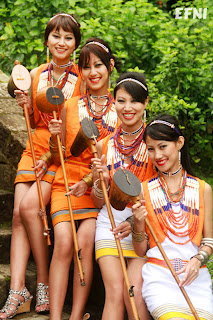
Tetseo Sisters - EF News International
Tetseo Sisters
Jim: Tetseo Sisters! One of the most popular female bands from Nagaland. With over 7000 fans on Facebook, hundreds of views of your YouTube videos every week and hundreds of live shows, how does it feel?

Tetseo Sisters: It has been a long but fruitful journey. We wake up every morning with renewed faith and enthusiasm to continue doing what we love to do. We love it…..the whole lot. There is no high like the high you get while performing on stage and getting warm applause at the end of each song.

We feel truly blessed to be a part of the current music scene. What we do is more than music. It is also about preserving and promoting Nagaland’s art & culture and fashion and creativity; and presenting “our best” to the audience every single time we get up or sit down to perform. The most rewarding thing about what we do is the constant learning process, meeting new people and wonderful personalities while sharing our music and also getting a chance to display our Naga culture and helping dispel the myths and negative impressions people have about our Land. We often have elders telling us how happy they are to see us keeping the old songs alive and how proud they are of us; and sometimes very young people walk up to us and tell us we inspire them. Such experiences are so humbling and at the same time a huge morale boost, making it worth all the extra pains and the effort.

Jim: Tell us little about Tetseo Sisters – the band. Like how did it start, when did it start, who were involved?

Tetseo Sisters: We hardly think of ourselves as a band but we have been singing together for as far as we can remember, right from our childhood. We are best known as the Folk singing sisters but we like to project ourselves as modern Naga artistes who are equally at ease performing Western Music and Naga Li, and doing great in both. We belong to the generation of change and adaptation and have coped pretty well, growing with the times and yet embracing our cultural heritage and identity.

We are four sisters and a brother and though you would often see us in twos or threes at shows, we try to perform together as a foursome whenever possible. The girls play “tati”, “bamboo drums” and “khro-khro” (gourd tamborine) and Mhaseve plays the guitar, keyboards and do the music arrangements. We started singing early on in the 90s but made maximum stage appearances in the early 2000s till date. We have appeared often on Doordarshan and performed to exclusive gatherings of State heads, distinguished guests, tourists and at private events; and also at many Concerts/Youth Fests/Cultural Festivals across the country and abroad. Our parents were the driving forces behind us all along and they continue to inspire and push us to do better everyday.

Jim: Your music is different compared to many other groups like you. How do you define your music?

Tetseo Sisters: Our music is simple, melodious and harmonic, focusing on vocals and involves oral presentation of stories. Our performances call for some translation as we sing mostly in the Chokri dialect and there is some storytelling and sharing too. We call our ‘Li’ the ‘songs of the people’ not just to catch attention but because they are truly the songs of the people.

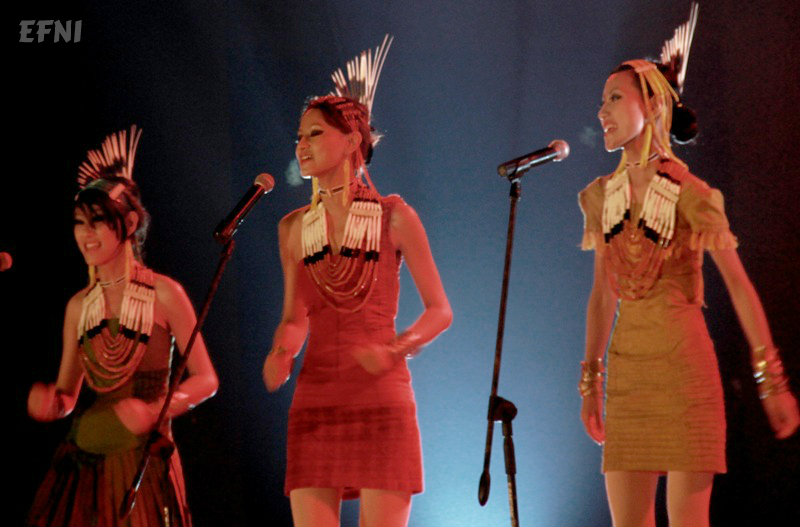
Li documents and records the stories and lives of our people, their dreams, aspirations, joys, sorrows, hopes and the happenings of daily life. We have great stage chemistry and our costumes add a lot of drama and color and for all the hard work that goes into it, our audiences love our shows and performances calling it very unique and enjoyable. Our western music performances are fun and we try to bring across a simple selection of covers of enjoyable popular hits, our playlist is carefully put together keeping our audience in mind.

Tetseo Sisters - EF News International, Bangalore
Tetseo Sisters
Jim: ‘Li : Chapter one - The Beginning’ is your debut album. What paved way for it?

Tetseo Sisters: Li : Chapter One is a result of more than 15 years of performing Li and a dream to put our efforts to bring out a visible product. We have tried to showcase a sample of Li that we have been singing over the years. The album has 12 tracks, all sung in Chokri dialect of the Chakhesang Nagas: a track for each month and a Christmas Li to top it all. Love songs, odes to women’s beauty, a lamentation, a lullaby, work songs and dueling duets make up the album. There are thousands of Li and choosing just 12 was not easy and we are very satisfied with the result. The feedback has been very positive and encouraging. People have loved it and want more.

Jim: Apart from music what interests the four sisters – Mercy, Azi, Kuku and Lulu?

Tetseo Sisters: Mercy and Kuku share a love for writing and blogging while Azi is quite the design diva as she loves playing with clothes, accessories and make-up when not tending to her newborn son, our darling little nephew. Lulu and Mercy love reading, surfing the net and watching movies. Kuku loves trekking, bike rides, painting and visiting new places. We are all fond of art, fashion - clothes, shoes and jewelry and dressing up for fun, photography, travelling, reading, shopping, cooking and trying out new cuisines.

We are just four simple girls enjoying the beauty of being alive and making the most of life with our loved and dear ones by God’s grace.

Jim: Do you think singing Traditional Folk Songs will give you the international mileage that you need at a time when people are more interested in rock, hip-hop or pop music? What do you think of the present music scenario?

Tetseo Sisters: There will always be fans for each genre of music. No kind of music is inferior or superior and tastes are as unique as the individuals who enjoy a certain type of music. Every generation thinks his or her time was the best and we also think we are in a very good period as far as opportunities and creativity is concerned. For instance, the worldwide web has made the world very small and has made accessibility to all kinds of music very easy. Everything is only a click away, including recognition and success. So visibility is also much more. The only setback is that this also means ‘clever marketing’ will make one more famous than real talent.

The world is always hungry for fresh tunes, talent and something special and ‘Li’ is all that. People say the language we sing in can be a deterrent to our success but we feel that everyone appreciates good music and language will never be a barrier if the music is great. The present music scenario has loads of talent, immense creativity and very competitive.

We also listen to a lot of different types of music since all of us have different tastes and many different artistes from around the world inspire us.

Tetseo Sisters - Eastern Fare News International, Bangalore
Tetseo Sisters at Williamnagar, Simsam, 2012
Jim: If any other group of musicians would like to follow your path, what would be your advice?

Tetseo Sisters: Our only advice is “do try and be the best you can be in whatever you do”. We are perfectionists in what we do so we keep doing our homework and it is hard and sometimes frustrating, but striving to be as professional as we can get is a reward in itself. A job well done is always fulfilling and we try to give our 100% every time.

Jim: What are your future plans? Any collaboration with other musicians?

Tetseo Sisters: Our plans are many. We are working on a couple of music projects of our own and also collaborating with other personalities. Collaborations are very exciting and we look forward to working with other artistes who believe in us and respect our work. We just did a Christmas single with Alobo Naga and launched it on YouTube. There is a docu-film by Anuska and Iswar called “Uramili” of which we are a part of, awaiting release. We have a few other projects under wraps as of now and more International appearances soon. A Christmas album, Folk-fusion album and Chapter Two are on their way.

We will continue singing, writing, updating and interacting with people via Facebook and our website www.tetseosisters.com and prepare for more performances, while engaging in art, photography and fashion whenever the opportunity arises.

Follow Tetseo Sisters on Facebook and Reverbnation
(Edited by Parmita Borah) 


Tuesday, January 8, 2013

Assamese musician Vicckey Goswami’s remarkable musical sojourn

‘Music is what feeling sounds like’, and that is what pours out of the award winning musician Vicckey Goswami. Hailing from a family dedicated to art and culture in Tezpur, Assam, this talented youth was drawn to music from a nascent age. A man of multiple talents, Vicckey has proved his skills as a drummer, percussionist, keyboardist, vocalist, and composer.

Vicckey Goswami - EF News International
Vicckey Goswami
Vicckey’s musical journey began as a music composer with the Ford Super Model show with Mehr Jessia Rampal in 1996, and has composed music for more than 200 Ad films. His latest score was for the Audi A8L TVC which won the Integrated Spikes Asia Award as well as the Goa Fest 2012.

Vicckey’s tribute composition to Late Bhupen Hazarika was released on Universal and featured Shankar Mahadevan, Kailash Kher and Shaan. He was invited to compose music for a Telecom Company in Uganda with a reputed local musician Kaweesa who arranged for children from an orphanage to sing, a project very that Vickey considers very close to heart.

Amongst, other achievements, the best composer award for Lowe Lintas for three consecutive years and RAPA Award for Radio Mirchi signature tune are just to name a few. Bollywood was not far behind when he won the Zee Cine Jury award for the best background score for the Salman Khan starrer Tere Naam. He was also a finalist at Cannes for the best sound design for his ST Gobbain Film.

Vicckey performed at the Groove Temple Concert in Goa with internationally acclaimed artists Prem Joshua and Talvin Singh on January 04, 2013. He is all set to release an album shortly. His consistent contribution to the world of music has won him genuine accolades.

- Edited by Parmita Borah

Friday, December 21, 2012

Hornbill Festival 2012, Nagaland ● Photo Showcase

Hundreds gathered at the the Hornbill Festival 2012, a week long celebration that showcases Nagaland's rich tribal culture. Launched in the year 2000, this visually extravagant festival is celebrated during the first week of December every year to celebrate Nagaland's socio-cultural heritage.

Named after the bird, Hornbill Festival is one of the largest celebrations of the indigenous warrior tribes of Nagaland and therefore re-enactment of battles is a core part of the performances. Every session at this festival is kicked off with the traditional war cry from the hundreds of performers in their traditional attire. The dance performances have different stories to tell - from harvesting to legends, as spectators sit in open-air ampi-theaters and relish their eyes on the kaleidoscopic view of art and culture.

This annual fete with an orgy of music, dance, traditional games and skills, food, films, beauty pageants and peace rallies forms a meeting ground for the age old traditions and the progressive artists of the state.

Sudeepta Barua shares some of the variegated moments of the Hornbill Festival that he captured though his lens.

- Edited by Parmita Borah

Hornbill Festival, Nagaland - Sudeepta Barua photography (© EF News International)
Hornbill Festival 2012, Nagaland (photo - Sudeepta Barua)

Hornbill Festival 2012, Nagaland - Sudeepta Barua photography (© EF News International)
Hornbill Festival 2012, Nagaland (photo - Sudeepta Barua)
Hornbill Festival, Kisama Village - Sudeepta Barua photography (© EF News International)
Hornbill Festival 2012, Nagaland (photo - Sudeepta Barua)

Hornbill Festival, Kohima - Sudeepta Barua photography (© EF News International)
Hornbill Festival 2012, Nagaland (photo - Sudeepta Barua)
Hornbill Festival, Kohima, Nagaland - Sudeepta Barua photography (© EF News International)
Hornbill Festival 2012, Nagaland (photo - Sudeepta Barua)
Hornbill Festival, Kisama, Nagaland - Sudeepta Barua photography (© EF News International)
Hornbill Festival 2012, Nagaland (photo - Sudeepta Barua)
Hornbill Festival, Kisama - Sudeepta Barua photography (© EF News International)
Hornbill Festival 2012, Nagaland (photo - Sudeepta Barua)

Hornbill Festival, Kohima, Nagaland - Sudeepta Barua photography (© EF News International)
Hornbill Festival 2012, Nagaland (photo - Sudeepta Barua)

Friday, December 14, 2012

Psychedelic evening with Deep Forest at Deep India concert

Electronica may be the flavor of the hour, but certainly not my first choice. Therefore a day before The Deep India Concert at Vivanta by Taj on December 13, 2012, I decided to chat up with Eric Mouquet, the front man of Grammy Award winning Deep Forest, and learn a thing or two about his music. (Click here to read Eric Moquet's interview). He clarified my doubt that although elctronica has become synonymous with mash-ups, club and dance music for my generation, his music has a wider scope to it. Deep Forest strives to create a synergy between technologies like sampling with deep rooted folk elements and even organic sound effects. Deep India is a spin off of that very concept.
Deep India Concert at Vivanta by Taj
For those who didn't know 'The Deep India concert' is a brief musical tour to promote the project 'Deep India', a collaboration between Deep Forest and Indian santoor player Rahul Sharma. The event was on the breezy evening of December 13, at Vivanta by Taj. Our moods pretty much in sync with psychedelic lights emitted by busy traffic, we reached an hour early for the concert and binged on yummy tidbits, standing next to an open bar.

I may still not be a trance/elctronica fan, but in all honesty, it was one hell of a show. Deep Forest kicked off the evening with some unhurried dreamy tracks, with David Fall on the drums, Alune Wade on the bass, Olyza Zamati - the vocalist, and the master himself Eric Mouquet on the keys (both on the keyboard and the laptop).

The highlight of the show has got to be composition 'Viva Madikere,' an ode to the enchanting hill station town Madikere. There's an interesting story behind this song. It so happened that Indian santoor player had recorded some drum beats, vocals and natural sound effects during his stay at Madikere and send them to Eric to get a flavor of the land. Inspired by the flavors of the place, Deep Forest worked on the song and named it 'Viva Madikere', which later paved way for the complete musical collaboration - Deep India. The audience were equally thrilled to groove to a Bihu song (traditional folk song of Assam) that Eric had fused with techno beats!

- by Parmita Borah                5HUE2USGAHPQ

Eric Mouquet of Deep Forest at Deep India Concert - Jim Ankan Deka photography
Eric Mouquet of Deep Forest at Deep India Concert (photo - Jim Ankan Deka)
Olyza Zamati at Vivanta by Taj, Bangalore- Jim Ankan photography
Olyza Zamati at Vivanta by Taj, Bangalore (photo - Jim Ankan Deka)
Alune Wade of Deep Forest at Deep India Concert, Bangalore, India - Parmita Borah photography
Alune Wade of Deep Forest at Deep India Concert, Bangalore, India  (photo - Parmita Borah)

Olyza Zamati at Deep India Concert, Vivanta by Taj, Bangalore- Jim Ankan photography
Olyza Zamati at Deep India Concert, Vivanta by Taj, Bangalore (photo - Jim Ankan Deka)
David Fall at Deep India Concert, Bangalore - Jim Ankan Deka photography
David Fall at Deep India Concert, Vivanta by Taj, Bangalore (photo - Jim Ankan Deka)
Eric Mouquet of Deep Forest at Vivanta by Taj, bangalore - Jim Ankan Deka photography
Eric Mouquet of Deep Forest at Vivanta by Taj, Bangalore (photo - Jim Ankan Deka)
Olyza Zamati of Deep Forest at Vivanta by Taj, Bangalore - Jim Ankan photography
Olyza Zamati of Deep Forest at Vivanta by Taj, Bangalore (photo - Jim Ankan Deka)
Eric Mouquet at Deep India Concert, Vivanta by Taj, India - Jim Ankan Deka photography
Eric Mouquet at Deep India Concert, Vivanta by Taj, India (photo - Jim Ankan Deka)

Thursday, December 13, 2012

Sitar Maestro who put Indian music on international map took his final bow

Pt Ravi Shankar | EF News International
Pt. Ravi Shankar (1920-2012)
I can't claim to know much about Pandit Ravi Shankar's music, nor much about music for that matter; but it is safe to say that with his demise, the world of music has suffered another massive blow, and not just in the Indian scene but on a whole global front.

In the 1960's when India was still struggling to segregate and discover it's own identity from that of the leftover influence of Brits, a musician from orthodox classical music background emerged as a music icon of the western hippie culture. Was it dumb luck that shot him to fame? Not Likely. Dumb luck is for Gangam Style, not the likes of people who understood and fused genres with polar differences and created a blend that could be grasped and loved by many.

The multi talented Maestro wrote the Oscar-nominated score for 1982 film "Gandhi," several books, and mounted theatrical productions. His popularity exploded in the west for his multiple collaborations with western musicians, George Harrison being the most enduring one. Amongst his numerous performances in the west the most notable ones include the Woodstock Music Festival, Monterey Pop Festival and one at the Concert for Bangladesh at Madison Square Gardens in New York City (of which he was a co-organiser along with Harrison). Pandit Ravi Shankar’s influence in classical music, including on composer Philip Glass, is equally noteworthy. His work with Menuhin on their "West Meets East" albums in the 1960s and 1970s earned them a Grammy, and he wrote concertos for sitar and orchestra for both the London Symphony Orchestra and the New York Philharmonic.

Pandit Ravi Shankar has been the recipient of many prestigious awards and recognition. Silver Bear Extraordinary Prize of the Jury at the 1957 Berlin International Film Festival, Sangeet Natak Akademi Award; the three highest national civil honours of India: Padma Bhushan, in 1967, Padma Vibhushan, in 1981, and Bharat Ratna, in 1999, just to name a few. He was made an honorary Knight Commander of the Order of the British Empire by Elizabeth II for his "services to music". He will also receive lifetime achievement Grammy award posthumously, making him the first Indian recipient of the award. The 55th annual Grammy Awards show will be held in Los Angeles on February 10, 2013.

Pt. Shankar’s contribution to Indian music is equally substantial – from composing music for Apu Triology to working as the music director of All India Radio, New Delhi, from 1949 to 1956. His legacy however, is not limited to being a brilliant sitar virtuoso; rather, the fact that he helped assimilate traditional Indian Raagas into the ever progressing world of rock and roll, thus opening the flood gates of fusion. He helped to craft and develop a genre of music that the whole world could understand, relate to and enjoy. While fusion experiments may not always be successful, but with the sitar going global and forming a core part of rock ballads, jazz and world music, Shankar threw light on centuries-old traditions of Indian music which would have otherwise remained unknown. Niklas Stålvind, lead guitarist of the Swedish heavy metal band ‘Wolf’ himself played the sitar on the track “Electric Raga. A synergy like that is feasible today, thanks to the vision that Pandit Ravi Shankar had many decades back.

There’s little wonder why George Harrison of Beatles labelled him as the ‘godfather of world music’.

- by Parmita Borah


Wednesday, December 12, 2012

Candid conversation with Eric Mouquet - frontman of Grammy Award winning Deep Forest

French duo Eric Mouquet and Michel Sanchez from the Grammy Award winning ‘Deep Forest’ are all set to perform in Bangalore. World music and Electronica enthusiasts can watch them live at The Deep India Concert on December 13, 2012 at Vivanta by Taj (6.30 PM onwards). Deep Forest is celebrated in the world music scene for fusing ethnic music with dance and chill-out beats. Their albums have sold over 10 million copies and they are also the recipients of the World Music Awards - French group with the highest 1995 world sales.

Eric Mouquet and Parmita Borah at Deep India Concert - Jim Ankan Deka photography
Eric Mouquet and Parmita Borah (© Jim Ankan Deka)
We managed to catch hold of the charming Eric Mouquet, a day before his performance at Vivanta by Taj, Bangalore, and spoke about his two decades long musical journey and his collaboration with Indian musician Rahul Sharma; and dig this – made him sing a Hindi song! Here’s an excerpt of our brief yet fun filled conversation –

Parmita Borah: It’s been twenty years that you’ve been associated with the music industry. How has your journey been?
Eric Mouquet: It’s been fantastic and adventerous. I didn’t imagine when we began, that we would come this far. I consider myself very lucky because I continue to travel, meet musicians, do shows and concerts. The beauty of this whole journey is that you get to meet new people and always have the inspiration to make new projects. So it’s been an amazing adventure.

Eric Mouquet of Deep Forest at Vivanta by Taj - Jim Ankan Deka photography
Eric Mouquet of Deep Forest (© Jim Ankan Deka)
PB: When we say ‘electronica’, mostly trance and mash ups come to mind; and there’s ‘ethnic eletronica’ which seems to have folk elements.
EM: It’s hard to say. When I was a teenager, electronica was preferred, it wasn’t dance at all, it was ambient music. Today it’s all about club and dance. I think every generation has it’s own taste (laughs). For me electronica is a way to use the synthesizer, and the sequencer and a way to compose music using technical things like sampling, analog and digital sounds. Ofcourse, trance is a part of it, and we will play trance at our performace tomorrow, but the scope of electronica is much wider than that.

PB: Of all your global collaborations, you’ve have recently collaborated with Indian musician Rahul Sharma. Tel us something about that.
EM: To be honest, I didn’t know Rahul Sharma before this project. Sony Music asked me to listen to Rahul Sharma’s Santoor works, it’s a very beautiful instrument and Rahul’s a very good musician. It’s always easy to work with a good musician because we speak the same language. Our project is supported by Vivanta by Taj, and therefore we will be performing in Bangalore and Coorg.

Eric Mouquet and Parmita Borah at Vivanta by Taj, Bangalore - Jim Ankan Deka photography
Eric Mouquet and Parmita Borah (© Jim Ankan)
PB: About your association with Vivanta by Taj, would you like to tell us something about that?
EM: Actually Rahul was in Vivanta by Taj, Madikere. There he recorded some nature sound effects, drum beats and vocals and sent them for me to get a feel of the place. Later we worked on the sounds, wrote a song and now we have a song called Viva Madikere, inspired by the beauty of the land.

PB: Did he teach you any Hindi song?
EM: None as yet.

I broke into the song ‘Pyaar Huwa Ikraar Huwa’ from Shree 420, and Eric Mouquet pretty much got it right at his second attempt, making me his first Hindi Teacher! Deep Forest will be performing on December 13, 2012 at Vivanta by Taj, 6.30 PM onwards. Catch them live at The Deep India Concert if you want to kick start your weekend in a cool way.

- by Parmita Borah

About Me

Powered by Blogger.

Blog Archive