This site will be shut down in

Friday, January 27, 2012

Spring Fest 2012, a Review

Spring Fest 2012, IIT Kharagpur
Every year, in January, the students of Indian Institute of Technology, Kharagpur, organises a festival - the Spring Fest with 'Brobdingnagian' enthusiasm. The Spring Fest 2012, a four days event, was no different at all. Spectators of Spring Fest 2012 witnessed some of the biggest names of the music and theatre industry in the country.

Started on Jan 20, the festival was managed by the students of IIT Kharagpur and held in the campus of the institute. With delegates and contestants coming from all over the country, Spring Fest is one of the biggest festival ever held in Kharagpur, West Bengal. The festival started with an inaugural ceremony followed by the events Sanskruti and Hasya Kavi Sammelan on Jan 20.

Wildfire, one of the country's biggest college rock competitions, went nationwide with prelims in cities like Bangalore, Delhi and Guwahati. The semi-finals of the competition started on Jan 21. The Mumbai based band Blakc, apart from performing in the fest on Jan 22, also acted as guest judge for the competition.

Jan 21 witnessed another famous music competition and an acoustic western event, Lake Side Dreams. The competition was judged by Bangalore based institute Eastern Fare Music Foundation's directors Jim Ankan Deka and Ankur Deka.

Some of the other events and competitions held on Jan 21 were Aurora, an audio–visual experiment, Israeli Classical by ‘Shye Ben Tzur’, Nukkad and the power house performance by the fusion band Mrigya.

Spring Fest 2012, IIT Kharagpur
Jan 22 started with a Youth Marathon in the morning followed by Wildfire semi finals, Model United Nations and a Bollywood Hiphop Dance Workshop. Later, people roared with laughter and applause while witnessing an energetic performance by famous Bollywood actor Makrand Deshpande in the Hindi play Miss Beautiful. The other famous performers of the play were Nagesh Bhosle and Divya Jagdale. The star performers of the third day event were the members of the Delhi based band Parikrama. With more than 3000 spectators, the Jnan Ghosh Stadium turned into a fireball.

Apart from many small events, Jan 23, the final day of the Spring Fest, started with an eastern music competition Sargam in the Netaji auditorium judged by Jim Ankan Deka and Ankur Deka.

Towards the evening a photography workshop, Picture Perfect, was organised for the new generation photographers.

The Spring Fest 2012 climaxed with a glorious performance by Bollywood music industry's famous duo Vishal - Shekhar.

Thursday, January 26, 2012

India Celebrates 63rd Republic Day

Thousands throng at the India Gate in Delhi to celebrate India’s 63rd Republic Day.

Republic Day parade
The customary Republic Parade, held every year, highlights the nation's achievements in various fields along with the military expertise, scintillating display of air power as also an assortment of the country's rich cultural heritage. This year the Agni-IV missile (3000 KMs Range) is the major highlight of the Republic Day Parade.The intermediate range surface-to-surface ballistic missile mounted on a road mobile launcher is being paraded by the Defence Research and Development Organization.

The Air Force contingent comprising 144 men will be led by Flight Lieutenant Sneha Shekhawatthe first woman ever to lead an IAF contingent at the Parade. The Army's Mechanized Columns concludes with a flypast by the Advanced Light Helicopter Dhruv of the Army Aviation Corps.C-130-J Super Hercules tactical aircraft, Indian Airforce’s latest also makes it debut at the parade as well.

The armaments put on display by the Indian Army includes the T-72 tank, Carrier Mortar Tracked, SMERCH Multiple Launch Rocket System, Pinaka Multi Barrel Rocket System, Full Width Mine Plough, NBC Water Purification Systems and Jammer Station VHF/UHF. The marching contingents of Navy comprising 144 men will be led by Lt. Commander Manikandan K.

Synchronized motor cycle stunts by Border Security Force, coordinated gymnastics by children for various parts of the country, Tableaux from 23 states and Central Ministries and Departments symbolizing historical, architectural and cultural heritage of the country are additional delights of the parade.

-by Parmita Borah

Saturday, January 14, 2012

Celebrating Nature's Bounty - Magh Bihu

The arid chill of the winter paves way for bright and brimming spring with the season of harvest at its threshold, giving people reasons to rejoice.

Photo courtesy - Alfresco Grand / Archana Bora
Magh Bihu or more appropriately Bhogali Bihu, one of the most important festivals of Assam,  is a paradigm of that spirit of festivity. The festival is known as 'Magh Bihu', since it marks the end of harvesting season in the month of 'Maagha', and 'Bhogali Bihu' for the fact that the celebration revolves around families getting together for a grand feast. Bhogali is derived from the Assamese word 'Bhog' which maybe interpreted as food and the name signifies that the stores and granaries in homes across the state are filled with the just harvested crop.

A large bonfire, referred to as 'Meji', and a feast, are the cardinal focus of Magh Bihu, although there are other fascinating traditions associated with the celebration. The feast being a part of the festivities is anything but obvious since Magh/Bhogali bihu commemorates a season of harvest.

On the eve of Magh Bihu, the night that is known as 'uruka', a large buffet dinner is prepared, often as a community activity, following a long preparation of traditional sweets known as 'Pitha'. Pitha is a rice-based fillet most commonly sweet in taste and on rare occasions salty. The night of Uruka is also spent by family members chatting around a bonfire, an activity that is also considered to a form of community watch guard to refrain mischievous youth and pranksters to cause any trouble. Traditionally on the eve of Uruka, pranksters sneak into people’s courtyards to taunt the owners.

Photo courtesy -
AssamInfo.Com / Utpal Sarma
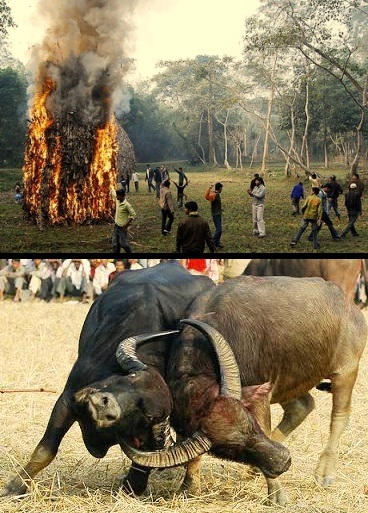
Preparation and burning of the Meji, the traditional bonfire, is possibly the greatest attraction of Magh Bihu. The groundwork begins a day before Magh Bihu. Sticks and leaves are collected and a rough hut called ‘Meji’ is constructed. The entire community spends the night in rough hay structures called 'Bhela Ghar', guarding their Meji. The exemplary feast is prepared to serve those who guard the Meji. Burning of the Meji , considered as a sanctified act begins with a ceremonial bath. The Meji is burnt and several rituals are observed around the burning bonfire. It is also customary for the lady of the house to make offerings of pithas and other eatables to the Gods. Once the rituals are over, various types of potatoes are roasted on the embers of the bonfire, and there is a session of feasting on these roasted vegetables. The proceedings end with a traditional firework display. The crackers are made of bamboo, and they are called Hiloi.

Other highlights of Magh Bihu include traditional sports activities including egg fights, bull fights and bird fights. 'Tekeli bhonga' or pot breaking is yet another much loved sport.

In any part of the globe, tradition and culture have always furnished a special spot for nature, and therefore with every cyclic change that nature bestows there follows a celebration that is vibrant and joyful. The people of Assam while truly embodying that spirit, extend their thanks to mother nature in this beautiful celebration of life called Magh Bihu.

-by Parmita Borah

Friday, January 13, 2012

Facebook Launches New Feature 'Listen With Friends'

A new feature on Facebook, is all set to ramp up the experience of listening to music online. ‘Listen with Friends’ as the feature has been christened, allows Facebook users to listen to music at the same time as their friends and discuss the tunes using Facebook Chat, with PC Mag reporting that up to 50 people will be able to listen and talk about the tracks at the same time.

Facebook product designer Alexandre Roche, in a blog post dated January 13, 2012 mentioned that- You can listen to the same song, at the exact same time - so when your favorite vocal part comes in you can experience it together, just like when you're jamming out at a performance or dance club.

‘Listen with Friends’ being a part of Facebook Chat allows users to chat online about what they are listening to. Users can also listen in as a group while one friend acts as a deejay. Up to 50 friends can listen to the same song at the same time, and chat about it. Everytime a user begins listening to music with a friend, a ‘story will be posted to her/his friends’ ticker and/or news feeds. Users will have control over who will be able to see when they are listening with a friend through their App Settings page after installing the compatible music app.

The service however can only be leveraged if both parties involved have access to the same online music programmes. Currently only Spotify and Rdio can be used in conjunction with 'Listen with Friends', although ZDNet claims that more services are set to be announced in the future.

The new feature created from collaboration between Facebook and Spotify gives users access to over 15 million songs, and will also allow them to see what tracks are trending on the site, as well as letting users share music with friends, as part of a free service. So if you weren’t addicted to Facebook already, here’s another reason to stay hooked on to this social networking website.

-by Parmita Borah

Saturday, December 31, 2011

Farewells in 2011

The reel of every passing year brings with a potpourri of joyous and aggrieved moments, convivial births and deaths. This year in particular witnessed some historic deaths; the most shocking ones being that of Osama Bin Laden and Mohammed Gaddafi, but especially of iconic figures whose impact of society and culture have been humungous. Let us take a moment here and remember the fond farewells that we bade in the year 2011.

Steve Jobs
Known for his showmanship in what is otherwise considered a geeky profession, Steve Jobs in his iconic turtle neck, jeans and sneakers took the world of technology by storm with Apple Mac and Lisa. Even when he was dethroned from his own company, Jobs moved to bring about another revolution in the world of animation with Pixar. When Apple roped him back, Jobs pioneered the ipod and the incredible radical consumer product the iPhone which soon evolved into the ipad. This legendary genius breathed his last on October 5, 2011, after battling for long with a rare form of pancreatic cancer.

Bhupen Hazarika
The Bard of Brahmaputra, Dr. Bhupen Hazarika placed Assam on the global cultural radar when he represented India in Berlin at the World Conference of Composers. His efforts towards integrating the Northeast with the rest of India, expressing political views with music, and using the platform of music as a ballista for social change are simply overwhelming. The people of Assam will remain ever grateful to him for carving a niche for Assam as a musically and culturally affluent land. When Dr. Hazarika passed away on 5 November 2011 an estimated half a million mourners arrived to pay their homage to this legend, which surpassed the number of mourners in Michael Jackson’s funeral.

Elizabeth Taylor
Multiple Academy Award winning screen Goddess of yesteryears and known for unforgettable portrayal of characters like Cleopatra, Elizabeth Taylor will always be remembered as a timeless beauty. Apart from the stardom, the legendary actress fondly known as Liz Taylor is also known for her activism and charitable foundation supporting AIDS and HIV positive victims. After suffering from many years of poor health Taylor died of congestive heart failure on 23 March 2011 at the age of 79.

M F Hussain
A contemporary artist from India, who rose to worldwide fame and controversy, Maqbool Fida Husain is another noted figure in the world of culture to have left this world this year. Often criticized for alleged misinterpretation of Hindu deities, M F Hussain left India in 2006. He also took a shot at Film Making and being the controversy’s child that he was, Hussain received a mixed bag of reviews for his work. His colorful personality and expressed fondness for a myriad of Bollywood actresses occasionally got his name printed on Page 3. M F Husain died, aged 95, on 9 June 2011, following a heart attack.

Dennis Ritche
Another mighty pioneer in the world of computers, Dennis Ritche helped shape the digital era and is was best known as the creator of the C programming language, a key developer of the Unix operating system, and co-author of The C Programming Language. In 1990, both Ritchie along with Ken Thompson received the IEEE Richard W. Hamming Medal from the Institute of Electrical and Electronics Engineers (IEEE), "for the origination of the UNIX operating system and the C programming language". Ritchie was found dead on 12 October, 2011, at the age of 70 at his home in Berkeley Heights, New Jersey. 

Computer historian Paul E. Ceruzzi had quoted: "Ritchie was under the radar. His name was not a household name at all, but... if you had a microscope and could look in a computer, you'd see his work everywhere inside".

Amy Winehouse
While most vocalists of her age and time engaged in creating peppy muzak, Amy Winehouse’s foray into fame came from her multifarious mix of RnB, Soul and Jazz, her distinctive style, and her powerful contralto vocals. However like most extremely talented musicians with the passage of time, her controversial battle with drugs, alcohol and various health problems took over her and she became a victim of her own demons. Winehouse died of an overdose on 23 July, 2011. Her musical career might indeed have been brief, but it was a reflection of pure talent, musical knowledge and a captivating personality.

Shammi Kapoor
Known as Elvis Presley of India for his western looks and bouncy dance moves, Shammi Kapoor remained a prominent romantic lead in Hindi cinema from the late 1950s until the early 1970s. Not many are aware but Shammi Kapoor was the founder and chairman of Internet Users Community of India (IUCI). He had also played a major role in setting up internet organisations like the Ethical Hackers Association. Kapoor maintained a website dedicated to the 'Kapoor family’. He died on 14 August, 2011, from chronic renal failure. Shammi Kapoor will be fondly remembered for his vitality and charm and for bringing many characters to life and making them memorable.

M. A. K. Pataudi
Fondly known as Tiger Pataudi, ex Indian cricketer and former captain of the Indian cricket team was as the ninth Nawab of Pataudi until 1971, when India abolished royal entitlements through the 26th Amendment to the Constitution of India. He was an Indian Cricket Cricketer of the Year in 1962, and a Wisden Cricketer of the Year in 1968. Tiger Pataudi breathed his last on 23 September 2011. His funeral was attended by myraid of film actors, directors and producers, as well as cricketing fraternity.

Jagjit Singh
Revered as one of the finest vocalists and a Ghazal maestro, Jagjit Singh was touted for contemporizing Ghazals with his melodic baritone voice and the infusion of western instruments in the genre. His silky voice ruled during early 80's in films like Prem Geet, Saath Saath and Arth. Singh crooned his last film song for Ashish Ubale's upcoming film Anandache Dohi. 

Jagjit Singh was the recipient of many prestigious awards including the 'Padma Bhushan', one of India's highest civilian honors by the Government of India. Singh’s career touched meticulous heights in the 70s and 80s and he came to be known as ‘The Ghazal King’ among music lovers. His collaboration with better half, ghazal singer Chitra Singh established them as the first ever successful duo-act (husband-wife) in the history of recorded Indian music. He died on October 10, 2011 at the age of 70 in Mumbai at Lilavati hospital, after suffering from a brain hemorrhage.

Kim Jong il
The supreme leader of North Korea (DPRK) from 1994 to 2011 Kim Jong-il was the General Secretary of the Workers' Party of Korea, Chairman of the National Defence Commission of North Korea, and the supreme commander of the Korean People's Army, the fourth-largest standing army in the world. In April 2009, North Korea's constitution was amended to refer to him implicitly as the "supreme leader". Among other titles e was also referred to as the "Dear Leader", "our Father", "the General", and "Generalissimo”. There are many mystical legends attached to his birth and lifetime.
Kim Jong-il died of a suspected heart attack on 17 December 2011.

- by Parmita Borah

Wednesday, December 21, 2011

Derek Paravicini - Musician or a Superhuman?

Derek Paravicini
There are people we say who are gifted. There are people who are differently abled. And there are people who have triggered their talents to do extraordinary deeds. But what can we say about a person who can listen to a ten minutes piano solo once and deliver a ditto rendition instantly? Can we call that person Superhuman?

Derek Paravicini is a pianist with superhuman talents. He is one of the few gifted people with 'absolute pitch'. He can listen to a song or tune once and can perform it on piano exactly the same. He can identify every note in a chord. While most musicians can pick out only five notes from a chord, Derek can distinguish up to 20. The irony is, Derek is blind and was born with a 'savant syndrome'.

Derek was born to Nicolas Paravicini and Mary Ann Parker Bowles on July 26, 1979. He was a 25 weeks premature baby weighing just a pound and a half and due to the oxygen therapy given during his time in a neonatal intensive care unit, lost his eye sight. He had a twin sister who died at the time of birth. In fact, doctors at the Royal Berkshire Hospital believed that Derek would not survive too, as any baby born 14 weeks prematurely in the hospital never survived. But Derek made it and today he is creating world records.

Derek started playing the piano from the age of two and later learned it thoroughly from Adam Ockelford in London. He showed talent from beginning and gave his first performance in the Tooting Leisure Centre in South London at the age of seven. As Derek was blind, he could not read music or take reference to an external standard of music. Moreover, Derek's emotional capacity is limited with severe learning difficulties and he can't read braille. But that did not stop him from understanding the essence of music. He had his ears to rely upon. And at the very age of nine, Derek gave his first major public performance at a concert at the Barbican Hall in London with the Royal Philharmonic Pops Orchestra.

After the inception, Derek did not have to look back. He has been playing at numerous concerts with famous musicians. He performed at places like Ronnie Scott's Jazz Club, Dumfries and Galloway Arts Festival, the Queen Elizabeth Hall and twice at Downing Street for Tony Blair and Gordon Brown.

He was featured on 'Wogan', a chat show on British television, hosted by Terry Wogan and 'NOVA's' "Musical Minds" episode, a popular science television series from the U.S. Later he was featured on 'Extraordinary People's' episode titled "The Musical Genius" on Channel 5 and was the main subject of a documentary film called 'Musical Savants'. Derek also became famous in US after appearing twice on the CBS News programme 60 Minutes.

Young Derek Paravicini at a Concert
For his outstanding ability to remember tunes, Derek is also known as 'The human iPod'. He can remember tunes which he had heard decades ago and play them exactly. His memory has a databank of thousands of songs and can play any one of them at will, improvising as he goes. And he prove this many times through his concerts.

Because of his unique ability, he was featured on History Channel's 'Stan Lee's Superhumans'. He has received many awards in the last three decades of his life. Alongside of 'Barnardo's Children's Champion Award' which he received as a ten year old from Princess Diana, there are numorous Performance-assessment certificates from the Associated Board of the Royal Schools of Music.

Despite being a masterful musician with all these achievements, Derek's condition makes him dependant on round-the-clock care and help with even the simplest of tasks - from dressing to washing. Presently he is staying at the residential care home in Redhill, Surrey, run by the Royal National Institute for the Blind, UK. Derek is the great-grandson of the writer William Somerset Maugham.

Professor Adam Ockelford, a music psychologist at Roehampton University and the mentor, coach and the biographer of Derek Paravicini says, “I have never heard anyone play quite like Derek. He can hear a song just once and play it back perfectly, adapting it and improvising along the way. He has thousands of pieces in his repertoire now. It's like he's got libraries of pieces and styles in his head”.

-by Jim Ankan Deka

Friday, December 16, 2011

Ritchie Valens - the Pioneer of Rock and Roll

There are not many musicians who could make it to the list of  'Rock and Roll Hall of Fame', and for someone with a track record of only eight (8) months in the music industry, it could be a mammoth task. Richard Steven Valenzuela or popularly Ritchie Valens was the first Hispanic rock star who could create a record like that.

Born in May 1941, in Pacoima, LA, Ritchie started his career at the age of sixteen with a band named 'The Silhouettes' as a guitarist. He was a left handed, but mastered the art of a right handed guitarist. He was known as one of the pioneers of 'Rock and Roll', 'Chicano rock movement' and 'Latin rock'.

Ritchie received worldwide fame with his version of a Mexican folk song called 'La Bamba' released in 1958. The song, infused the traditional Mexican tune with a rock drive, ranked number 98 in VH1's 100 Greatest Songs of Rock and Roll and number 345 on Rolling Stone magazine′s list of the 500 Greatest Songs of All Time. This is the only non-English song to be listed.

Ritchie Valens (1941-1959)
In 1958, Ritchie was introduced to Bob Keane, the owner and President of Del-Fi Records, who recorded few of the famous numbers of Ritchie like 'Donna', 'Framed' and 'Come On, Let's Go' in the Gold Star Studios in Hollywood. Ritchie has three albums all together - Ritchie Valens (1959), Ritchie (1959) and In Concert at Pacoima Jr. High (1960).

Ritchie was still in his teens at the time of his demise caused by a plane crash. He was on a plane on February 2, 1959, after his performance in Clear Lake, Iowa, which crashed shortly after takeoff in a snow storm.

For someone who could have adorned the throne of fame and success in the realm of music, Ritchie's death was tragic and untimely. His contribution to music though limited by his short lifetime, is remarkable and defining. Today we remember his death as 'The Day the Music Died'.

-by Jim Ankan Deka

About Me

Powered by Blogger.

Blog Archive